Starships and More
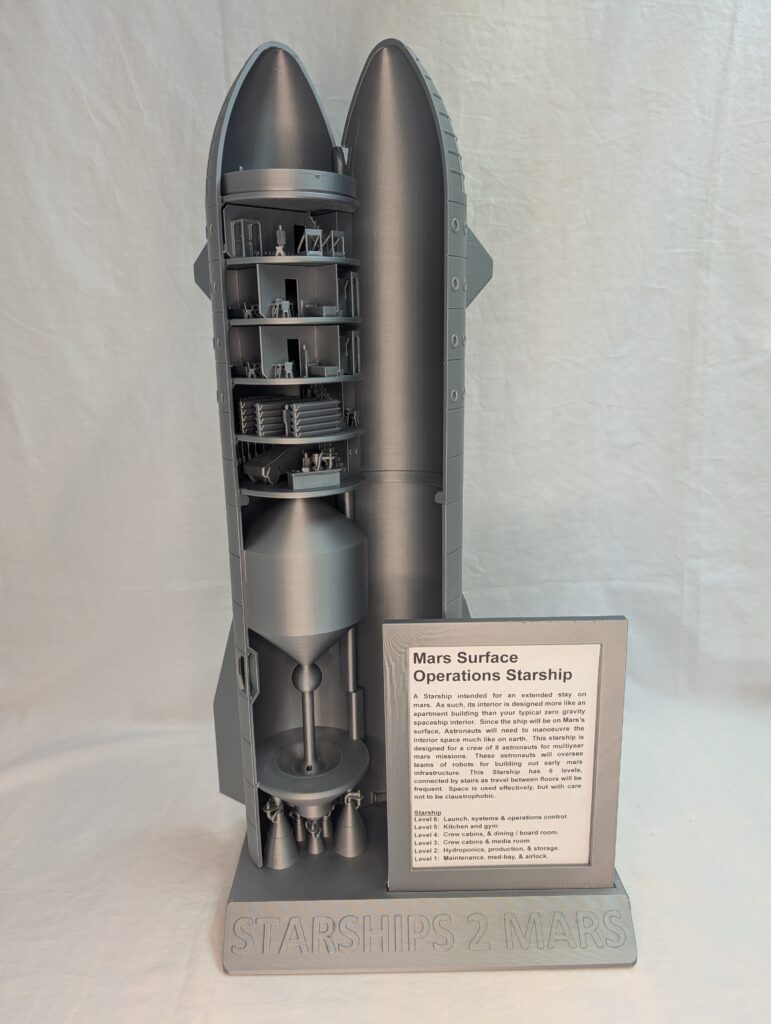
Mars Surface Operations Starship
A Starship intended for an extended stay on mars. As such, its interior is designed more like an apartment building than your typical zero gravity spaceship interior. Since the ship will be on Mars’s surface, Astronauts will need to manoeuvre the interior space much like on earth. This starship is designed for a crew of 8 astronauts for multiyear mars missions. These astronauts will oversee teams of robots for building out early mars infrastructure. This Starship has 6 levels, connected by stairs as travel between floors will be frequent. Space is used effectively, but with care not to be claustrophobic.
Starship
Level 6: Launch, systems & operations control
Level 5: Kitchen and gym
Level 4: Crew cabins, & dining / board room.
Level 3: Crew cabins & media room
Level 2: Hydroponics, production, & storage.
Level 1: Maintenance, med-bay, & airlock.
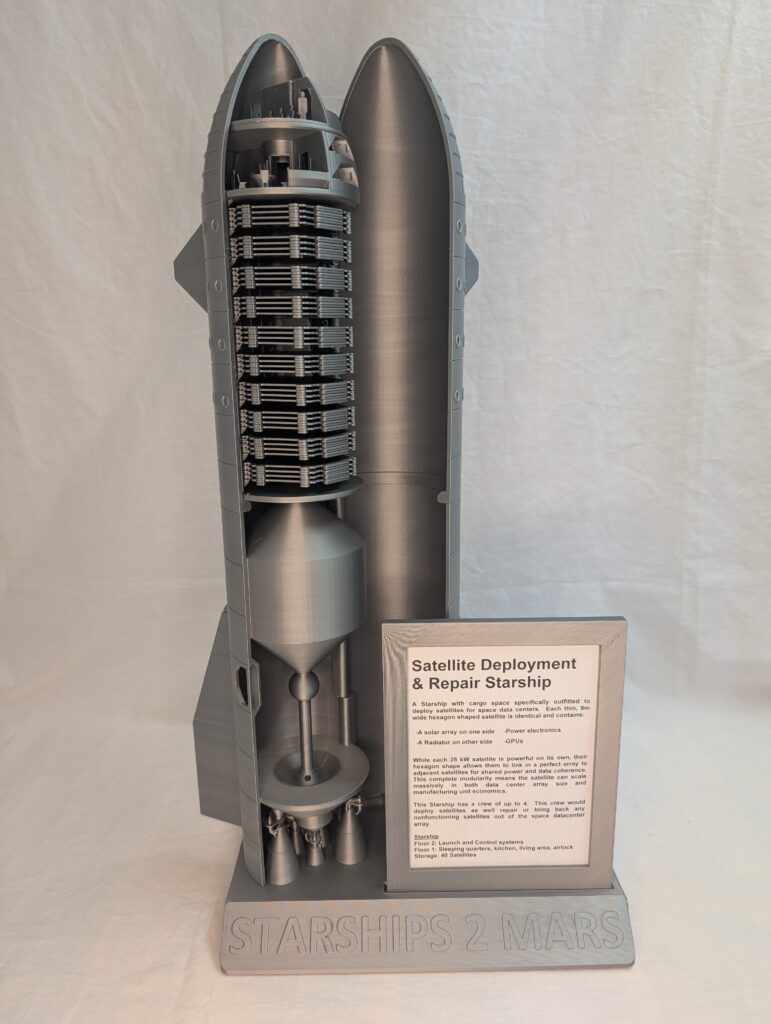
Satellite Deployment & Repair Starship
A Starship with cargo space specifically outfitted to deploy satellites for space data centers. Each thin, 8m wide hexagon shaped satellite is identical and contains:
– Solar array on one side – Power Electronics
– Radiator on other side – GPUs
While each 25kW satellite is powerful on its own, their hexagon shape allows them to link in a perfect array to adjacent satellites for shared power and data coherence. This complete modularity means the satellite can scale massively in both data center array size and manufacturing unit economics.
This Starship has a crew of up to 4. The crew would deploy satellites as well repair or bring back any nonfunctioning satellites out of the space datacenter array.
Starship
Floor 2: Launch and Control systems
Floor 1: Sleeping quarters, kitchen, living area, airlock
Storage: 40 Satellites
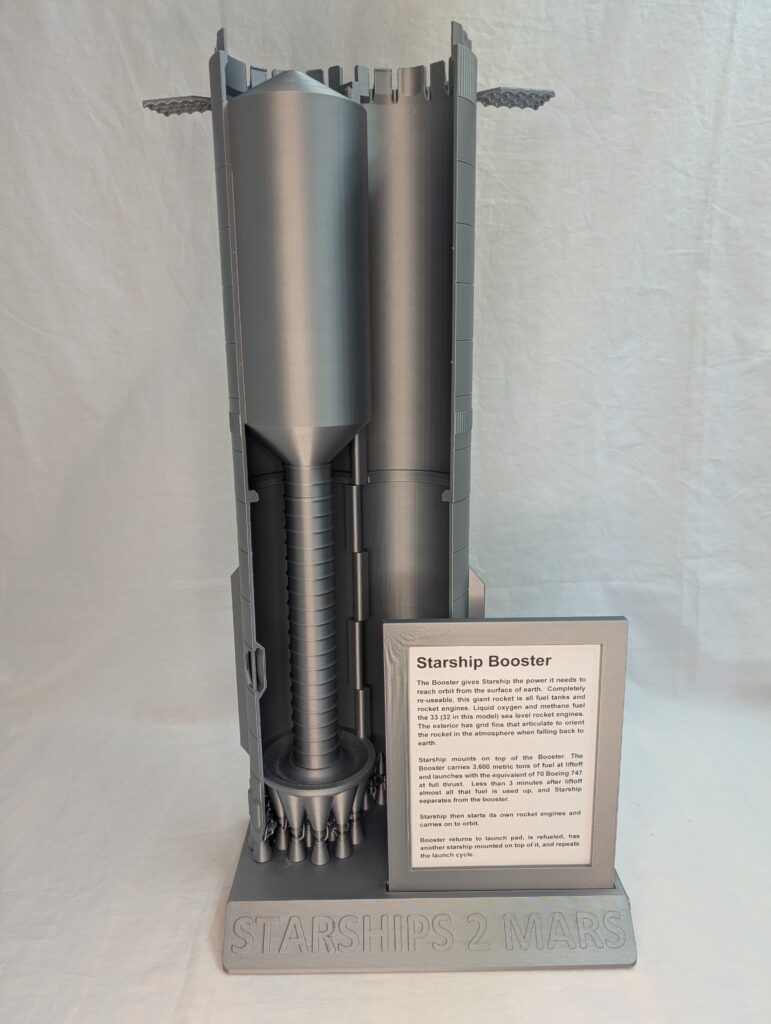
Starship Booster
The Booster gives Starship the power it needs to reach orbit from the surface of earth. Completely re-useable, this giant rocket is all fuel tanks and rocket engines. Liquid oxygen and methane fuel the 33 (32 in this model) sea level rocket engines. The exterior has grid fins that articulate to orient the rocket in the atmosphere when falling back to earth.
Starship mounts on top of the Booster. The Booster carries 3,600 metric tons of fuel at liftoff and launches with the equivalent of 70 Boeing 747 at full thrust. Less than 3 minutes after liftoff almost all that fuel is used up, and Starship separates from the booster.
Starship then starts its own rocket engines and carries on to orbit.
Booster returns to launch pad, is refueled, has another starship mounted on top of it, and repeats the launch cycle.